

This Earth Day marks five years since Media Two made a commitment to carbon neutrality. As a way to pay it forward, I’m sharing our story with the hope it may inspire others to think differently about environmental responsibilities.
It’s been enlightening to gain a deeper level of understanding of what “carbon neutrality” actually means for us as an ad agency – or rather what it doesn’t mean. We’ve come to understand that our footprint isn’t just about measurement in a traditional sense. If you’re unfamiliar with measurement standards, I recommend reading up on scopes 1, 2, and 3 emissions. It’s an interesting system, but it’s also lacking application for every industry.
That one-size-fits-all approach is what’s led us on a journey as an organization to reconsider our efforts from a new perspective. We began to recognize our missteps, blind spots, and where we can be doing more than what various measurement protocols suggest.
It’s been nearly a year since we sat down as a group and had a heart-to-heart about the negative impacts our industry actually has on the environment – not just what we directly influence through our operations, but what our full impact is through the campaigns we manage. We all had stories to share, concerns for the future, and a genuine desire to be better as individuals and an organization. More importantly, we learned a lot from each other. In particular, there was an underlying concern for the growth of AI and its impact.
It’s not news that AI is now inherently being integrated into all things media. It’s in our media planning, our search strategies, data analytics, and built into the backend of nearly every server-side technology we use. We serve billions of ads every year, and the tools required to do that is scaling at a rate we’ve never before seen.
To put things into perspective for the casual AI user, a single query or prompt burns enough electricity to power a lightbulb for two minutes, and creating the average AI generated video is the equivalent of running your microwave for ten minutes.
Take any ethical concerns about dehumanization out of the equation, and AI’s environmental impact alone should worry you. By 2030, it’s expected that nearly 10% of the world demand for electricity will be from AI with the potential water usage for cooling data centers projected at 1.7 trillion gallons. That’s about the same as the yearly usage of every California household combined.
So, what is a media agency to do? Two of the biggest concerns we had with our own efforts was a lack of transparency, and the inability to account for our campaign footprints. While we fully embraced the notion of paying for offsets, it seemed empty. Dollars out the door to projects on the other side of the world didn’t really show us the impact on a personal level, and concerns for who stood to profit made us question the efficacy of the entire system.
After much discussion and brainstorming, here’s where we landed, and here’s what it means we’re doing. In sum, we’ve doubled down on our measurement and investments, and we’ve added a bit of personalization to our full approach.
Step 1: Measurement
Tracking our company emissions using GHG Protocol was a good start, but as I mentioned, it did not effectively cover emissions resulting from our client campaigns. For that, we had to take into account digital and traditional advertising and the footprint necessary to serve all impressions (text, display, video, broadcast, OOH, print, etc.). So we added these calculations on top of our standard measurements to get a better understanding of our actual impact. While there are calculations for each media type, it works out to roughly a half metric ton of CO2e for every million impressions.
Step 2: Investment
Our past offset investments were great, but not personal. As a people-first organization, we wanted investments to mean something to everyone. Our task force researched and identified eight different offset partners and platforms offering access to hundreds of projects. Freedom of choice meant that every employee could pick where their allocation for offset funding went. Local, regional, or international options opened the door to a level of personalization that made sense for every individual preference.
Step 3: Action
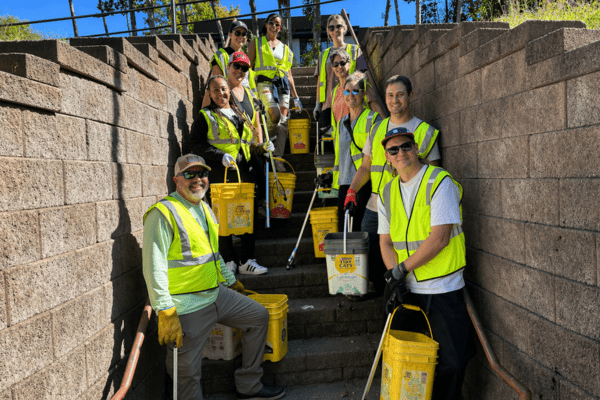
Finally, as a gritty and hands-on kind of company, we all agreed that it just felt right to do some of the work ourselves. So twice a year, we roll up our sleeves and spend a day with our friends at The Great Raleigh Cleanup making pieces of our own community greener, cleaner, and brighter. This is a fantastic organization, and I highly encourage finding a way to work with Preston Ross and his team if you’re anywhere near the Triangle or central North Carolina. Next week, we’ll be coming together for our first clean-up day of 2026, and we can’t wait!
Final Thoughts
To wrap things up, I hope this has been helpful or inspiring. Maybe it makes some of you rethink your current efforts, or perhaps it jump-starts your efforts altogether. Either way, this has been a fun and fulfilling journey for us, and it’s one we plan to continue for many years to come. It’s a great reminder for all of us to live our lives by the simple message to Do The Right Thing!